
EOD Electronics (5 Days)
$22,500.00
Description
This 5-day (40 hours) course will give you the technician level skills you need to perform wire diagnostics and build your own training devices.We teach to the technician level to give you skills rather than talking over your head to prove how smart we are. The circuit case studies in the course are a good mix of overseas and US incidents with some conceptual EOD problems to reinforce EOD skills. We will start out on the breadboard but quickly move on to soldering PCBs so you will have something to show for your time. Our live training interface allows you to ask the instructor questions and get answers in real time. Recordings of class are posted within ten minutes after class in case you have to miss class for any reason. The instructor will also be available after class for 1:2:1 office hours for any of the topics you need extra help with. You will have lifetime access to the course materials on EOD Maker!
n
n
n
Day 1: DC Theory (Resistors, Batteries, Capacitors and Switches)
n
nLecture:
n
nThe lecture is focused around the various passive components found in IEDs and the foundational concepts that explain their behavior in IED circuits. These concepts will also be related to EOD procedures by examining how DET Diagnostics and Ohm’s Law line up.
n
n
n
nLab:
n
nMultimeter tutorial.
nBreadboard simple circuits and test with supplied multimeter. Observe capacitor charging and voltages across open, closed and EOL switches.
nSolder breadboard leads to switches.
n
n
n
n
Day 2: Relays, Diodes, Transistors, MOSFETs, and SCRs
n
nLecture:
n
nThe lecture is focused on the common firing switches used in IEDs in the past 20 years. Students are introduced to electromechanical and semiconductor firing switches through their Schematic Symbols, Data Sheets and Example IED Circuits.
n
n
n
nLab:
n
nBreadboard five historical IEDs using supplied components.
nBuild Dual SCR IED Circuit Board.
nBuild RC Timer Board.
n
n
n
n
Day 3: IC Chips, Logic Chips and RCIED Circuits
n
nLecture:
n
nThis lecture will cover IC chips used in IEDs historically and their evolution into the Victim Operated and RCIED devices from recent conflicts.
n
n
n
nLab:
n
nBuild RFT-2 on supplied PCB.
nBuild DTMF PIC IED Circuit Board and interface with COTS radio (similar to DTMF-11).
n
n
n
n
Day 4: Programming Concepts and Arduino Applied to IEDs
n
nLecture:
n
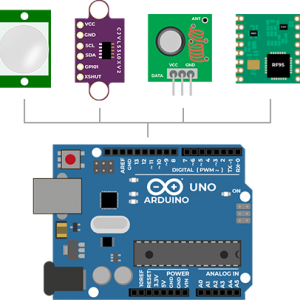
nThis lecture is focused on dividing and classifying the microcontrollers used in IEDs and the process of developing code and hardware for an IED. Practical examples of historical microcontroller IED circuits will be presented and adapted for the Arduino Lab
n
n
n
nLab:
n
nInstall Arduino IDE and libraries
nBuild Arduino Light Meter (from source code)
nBuild TOF LIDAR Counter
nBuild Hope RF PIR Device
n
n
n
n
Day 5: Alarm Theory & Wire Diagnostics
n
nLab:
n
nWe will start off with the relevant portions of basic alarm theory to relate the principles of security systems to IEDs. Students will learn different wire configurations for alarm sensors and how to establish wire pairs for wire attack. Students will then use the electronics principles they have learned behind wire and detonator diagnostics to perform tabletop defeat procedures on several different wire attack cases.
n
n
n
nWe suggest using your First Line Kit for this section but it can be accomplished with the student kit provided.
n
n
n
nBasic Alarm Theory
nMultimeter and Current Meter
nSpecialized Probes and Wire Access
nWire Diagnostics (Establishing Wire Pairs)
nWire Attack (Implementing Switch Defeat)
nDetonator Diagnostics
nPractical Exercises
n
n
n
nDeliverables:
n
-
n t
- Lab kits (Breadboard, Multimeter, Soldering Iron, Parts Kit, COTs timer and DTMF Radio, Arduino boards and corresponding device builds)
- Student Training guide with schematics & diagrams
- CAD files and source code (from the labs)
- Certificate of Completion
n t
n t
n t
n
nIncludes lifetime access to course materials.
Related products
-
DC Electronics
$499.00 Add to cart -
Eagle CAD for EOD
$29,999.00 Add to cart -
Arduino
Read more -
EOD 3D Printing and Fusion 360 Online
Price range: $899.00 through $9,999.00 Select options This product has multiple variants. The options may be chosen on the product page