
AI Principles for EOD — 5-Day MTT
$24,690.00
One Mastering AI: From Foundations to Deployment textbook included for each student!
New for FY27: a 5-day, 40-hour Mobile Training Team course on local open-weight AI models and edge deployment for up to 10 students — every model runs offline on hardware each student builds and keeps. Includes a spectrum analyzer lab for troubleshooting robot control links and comms, a student-built Raspberry Pi terminal with 3D-printed enclosure, and a Bambu A1 mini printer that stays with your unit. No laptops required — the kit IS the computer.
Description
AI PRINCIPLES FOR EOD (5 DAY) 40HRS
(Price includes course, a complete take-home hardware kit for each student, one Mastering AI: From Foundations to Deployment textbook for each student, and a Bambu Lab A1 mini 3D printer that stays with your unit — for up to 10 students)
Artificial intelligence is changing how the EOD community trains, builds, and fights — and the only way to own it is hands-on, offline, on hardware you control. This 5-day course is built around local open-weight models and edge deployment: every model your students run is open-weight, quantized, and running entirely on hardware in front of them — no cloud account, no internet connection, no data leaving the room. No programming experience required, and no laptops required: each student’s kit IS their computer for the week, and they keep all of it.
The Student Kit (yours to keep):
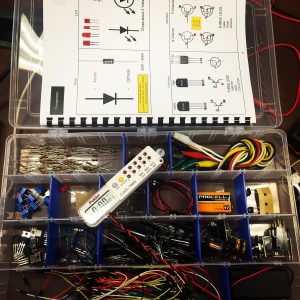
Arduino Uno Q edge AI computer with 7″ touchscreen and keyboard · Raspberry Pi portable terminal that each student builds and encloses in parts they 3D print in class · RTL-SDR software-defined radio with antenna kit · USB camera and mic/speaker for vision and voice labs · full sensor bundle, breadboard, and components · a preloaded open-weight model library (Llama, Qwen, Gemma — GGUF quantized) · and a working offline RAG reference assistant built on Improvised Electronics course content.
Schedule of Events:
Day 1: AI Principles & Local Open-Weight Models
Lecture: How large language models actually work — training, inference, and their limits. The open-weight model landscape (Llama, Qwen, Gemma, Phi, Mistral), quantization and GGUF, licensing, and why local models matter for OPSEC and disconnected operations in the EOD and public safety bomb tech community.
Lab: Boot your kit, and run your first open-weight models completely offline on the Arduino Uno Q. Benchmark model sizes and quantization levels against real hardware limits.
Day 2: Edge AI on Open-Source Hardware
Lecture: The open-source hardware ecosystem and what “edge deployment” really means — running inference on the device, at the point of need, with zero connectivity.
Lab: Build sensor rigs on the Uno Q, run on-device computer vision with the kit camera, and stand up an offline voice assistant — every inference local, nothing leaving the bench.
Day 3: SDR & the RF Spectrum — Spectrum Analyzer Lab
Lecture: Software-defined radio fundamentals and the RF environment bomb techs actually work in.
Lab: Turn your kit into a working spectrum analyzer and use it the way you will back at the shop — troubleshooting robot control links, verifying transmitters and antennas, and hunting interference in your comms. Then put AI on top: automated signal detection and classification at the edge.
Day 4: Build Your Terminal & AI-Assisted Software Development
Lecture: AI pair programming — from “I’ve never written code” to working tools in an afternoon.
Lab: Assemble your Raspberry Pi portable terminal, slice and 3D print your own enclosure parts on the class Bambu A1 mini, and use an AI coding assistant to build and ship a working EOD utility that runs on it.
Day 5: Scenarios, Paperwork & Air-Gapped Deployment
Lecture: Using AI to generate realistic, technically accurate training scenarios, lesson plans, and courseware — and to automate the reports, forms, and recurring paperwork that eat your week. Deploying and maintaining AI in constrained and air-gapped environments.
Lab: Capstone — teams combine their edge hardware, offline models, and workflow automation into a final project briefed to the class.
What’s Included:
Each student receives their own copy of Mastering AI: From Foundations to Deployment and keeps their complete kit — Uno Q, touchscreen, keyboard, Raspberry Pi terminal, SDR, camera, audio, sensors, and preloaded offline model library. Your unit keeps the Bambu Lab A1 mini 3D printer. Instructor travel included. No laptops, software licenses, or IT support required — nothing in this course touches your network.
Related products
-
Sale!
USAF EOD Electronics
Original price was: $32,500.00.$24,650.00Current price is: $24,650.00. Add to cart -
AI Edge Computing Drone Applications Course — 2 Week MTT
$59,999.00 Add to cart -
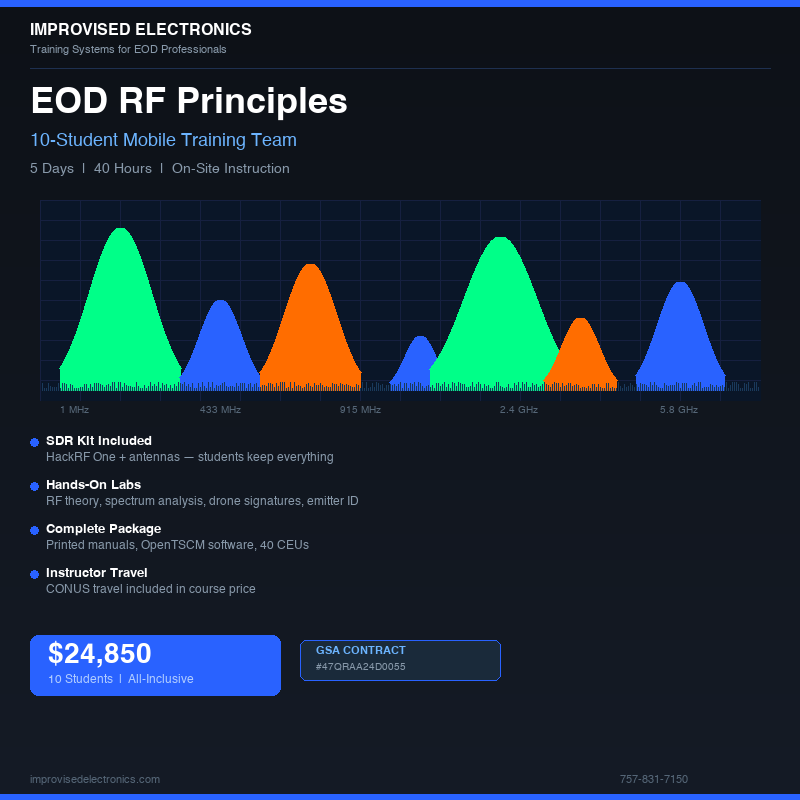
EOD RF Principles — 10-Student Mobile Training Team
$24,850.00 Add to cart -
Basic IED Electronics
$23,500.00 Add to cart