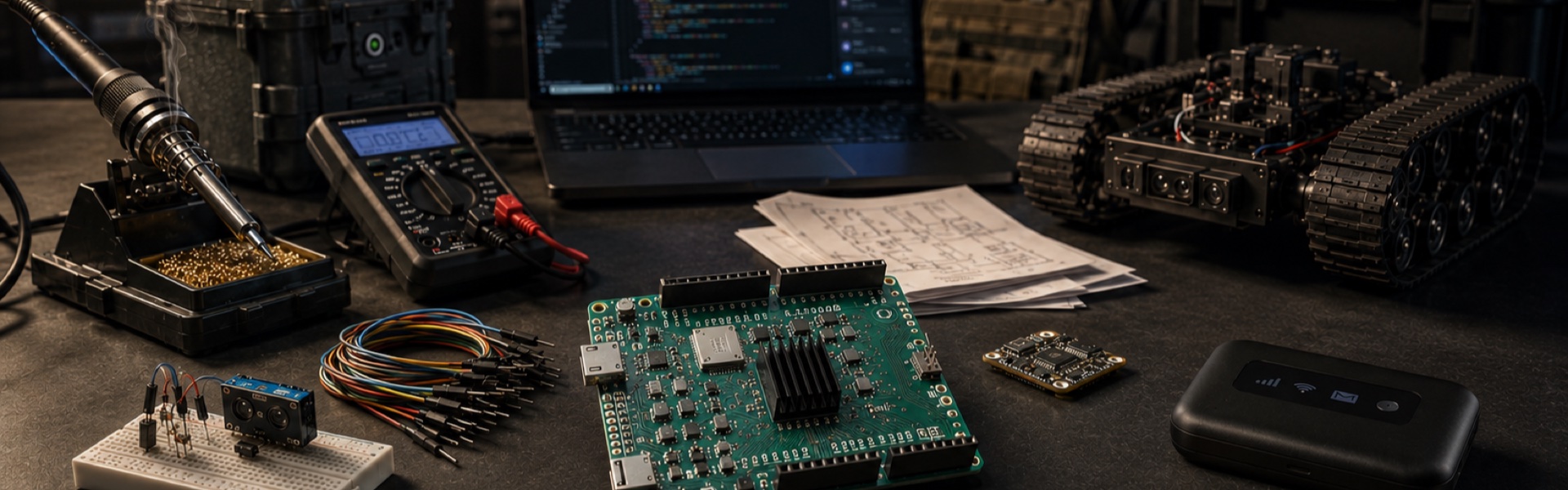
Open-Source Mission Electronics: Arduino Build Course — 1 Week MTT
Price range: $24,999.00 through $44,999.00
5-day, 40-hour Mobile Training Team for non-EOD military and public safety operators. Arduino UNO Q + AI-assisted coding. Each student walks out with a mission-relevant capstone build they assembled themselves.
Description
Open-Source Mission Electronics: Arduino Build Course
5-Day, 40-Hour Mobile Training Team for non-EOD military and public safety operators. Built on the new Arduino UNO Q. AI-assisted. Mission gear in your hands by Friday.
This is not an EOD course.
This 5-day MTT is purpose-built for non-EOD military and public safety operators — federal LE tech, military intel and signals, fire and HAZMAT tech teams, SAR, fusion centers, and border / customs tech. EOD units looking for bomb-tech specific training should see EOD Electronics, sUAS Construction Build Class, or sUAS Construction & Autonomy Course.
Hands-On 5-Day MTT for Operators Who Need to Build Mission Gear
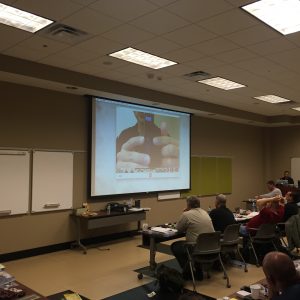
This 5-day, 40-hour Mobile Training Team (MTT) brings hands-on mission electronics directly to your unit. Students don’t need a coding background and don’t need to be electrical engineers. The course is built around the new Arduino UNO Q — Qualcomm Dragonwing application processor on one side, STM32 real-time microcontroller on the other, both on a single Arduino-form-factor board — and is taught with AI-assisted coding so non-technical operators can produce working firmware in days, not months.
Each of the 10 students walks out Friday with the gear they built themselves: a personal Arduino UNO Q, a capstone build (UGV, basic educational quad, custom control panel, or field-deployable edge sensor box), a personal soldering iron and tool kit, a printed lab guide, and a digital reference package with the full AI prompt library used in class. The same prompt patterns can be reused at the unit on follow-on builds — this course doesn’t end at the certificate.
Why This Course
Built for non-EOD operators
Federal LE tech, military intel / signals / SOF support, fire, SAR, fusion centers, border & customs tech, corrections tech, state and local LE tech.
Mobile Training Team format
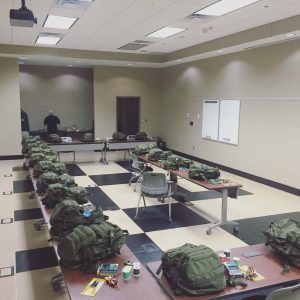
We come to your unit. All parts, kits, consumables, and bench laptops included for 10 students. CONUS or APO consolidated through IE San Diego.
The new Arduino UNO Q at the center
Qualcomm Dragonwing-powered. Linux on one side, real-time microcontroller on the other. The same board the next generation of edge-AI products is being built on.
AI-assisted coding throughout
Students don’t need a programming background — they learn prompt fluency for hardware. The AI writes the firmware; the operator owns the build.
Four capstone tracks, working prototype Friday
Day 5: UGV, basic educational quad, custom operator control panel, or field-deployable edge sensor box. Every student demos a working build.
Smarter consumers in the defense market
Operators who can build a rough prototype on their own bench write better requirements, spot weak vendor claims faster, and identify when a $50K commercial product could be replaced by a $200 sensor and a weekend of work. The course pays for itself the first time it prevents a bad acquisition.
Network-independent by design
IE supplies the bench laptops and the cellular hotspot. AI tooling runs on IE-owned hardware, IE-owned bandwidth. Course never touches your unit’s network.
Optional bench package stays with the unit
$20K upgrade equips your unit with 10 professional bench stations after the class — soldering, hot-air rework, bench multimeter, PSU, scope, logic analyzer. Stand up an in-house electronics shop in one engagement.
Reference package and prompt library, post-course
Code samples, schematics, BOMs, and the entire AI prompt library used in class — students take it home and the unit reuses it.
Daily Structure
- Day 1 — DC Fundamentals & Bench Skills. Ohm’s Law, Kirchhoff, multimeter, breadboarding, through-hole soldering, units, safety. End-of-day artifact: working series/parallel test board.
- Day 2 — Components & Six-Step Troubleshooting. Resistors (fixed/variable, thermistor, photoresistor, varistor), capacitors and dielectrics, diodes, BJTs, MOSFETs. Students diagnose a broken circuit using the Six-Step Method.
- Day 3 — Arduino UNO Q + Sensors + Radios + AI-Assisted Coding. Linux/MCU split, digital and analog I/O, PWM, ADC, I2C/SPI sensors (PIR, ultrasonic, ToF, IMU), LoRa/cellular radios. Sensor reading transmitted wirelessly to a dashboard — written by AI, read and modified by the student.
- Day 4 — Electromechanical Systems. Motors, servos, steppers, motor drivers, relays, solenoids. Sensor-triggered actuator integration. End-of-day artifact: closed-loop control demo.
- Day 5 — Mission Capstone Build. Student-selected track: UGV, basic educational quad, custom controls, or edge sensor box. Field demo to the class. Every student walks out with their build.
What’s Included — Base SKU $24,999
- ✓10-student Mobile Training Team — lead instructor included
- ✓Instructor travel, lodging, and per diem
- ✓All parts, kits, and consumables for 10 students
- ✓10 IE-supplied bench laptops + portable cellular hotspot (network-independent — never touches your unit’s network; laptops returned to IE)
- ✓Pre-loaded AI tooling, Arduino IDE, Arduino App Lab, and the IE prompt library
- ✓Arduino UNO Q (4 GB / 32 GB) for every student to keep
- ✓Arduino Nicla Vision / Sense ME (capstone-dependent) for every student
- ✓Capstone-track parts (UGV, Basic Quad, Custom Controls, or Edge Sensors)
- ✓Personal soldering iron + bench tool kit per student — students keep
- ✓Printed lab guides + digital reference package + AI prompt library
- ✓APO / CONUS shipping consolidated through Improvised Electronics San Diego
- ✓Course completion certificate and post-course After Action Report
What’s In The Bench Stay Upgrade — +$20,000
Add the Bench Stay upgrade and you stand up a complete in-unit electronics shop in a single engagement. After the class wraps, 10 professional bench stations stay with the unit — not loaned, not returned. Combined with the sustainment kit and 12-month digital reference library access, your operators keep building gear long after the instructor flies home.
- ✓10 × professional soldering stations with hot-air rework
- ✓10 × bench multimeters
- ✓10 × variable bench power supplies
- ✓10 × pocket oscilloscopes
- ✓10 × logic analyzers
- ✓12-month sustainment kit — spares, common parts, replacement consumables
- ✓12-month online access to the IE digital reference library
Day 5 Capstone Tracks
Students pre-select a capstone track at PO. All four tracks run in the same room on Day 5. Every student demos a working prototype to the class.
UGV
Build: Wheeled rover, differential drive, ultrasonic + IMU, radio remote, FPV camera.
Real-world use: Recon, hazmat surrogate movement, evidence recovery, force-protection wall-of-eyes.
Basic Quad
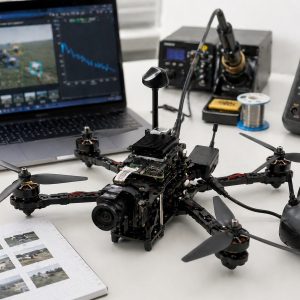
Build: Entry-level educational quadcopter, single-board flight controller, 5″ frame. Line-of-sight flight only — no FPV, no payload, no autonomy.
Real-world use: Familiarization for SAR observation, perimeter checks, building-clear practice. For production-grade FPV / loitering / payload-capable drones, see sUAS Construction Build Class.
Custom Controls
Build: Operator panel — color screen, buttons, encoders, joystick. Interfaces to a sensor or motor demo. Enclosure 3D-printed in class.
Real-world use: Custom dashboard for existing duty gear, ad-hoc controller for a sensor package, training rig at the unit.
Edge Sensors
Build: Battery-powered, weatherized sensor box. LoRa or cellular backhaul, on-device ML (Nicla Sense ME or Nicla Vision), 3D-printed enclosure.
Real-world use: Covert perimeter, asset tracking, environmental monitoring, low-power persistent surveillance.
AI-First Methodology — Vendor-Agnostic
This course teaches a repeatable AI-assisted build pattern that non-technical operators can apply to any mission electronics problem they encounter back at the unit:
The methodology is intentionally vendor-agnostic in marketing — units with Copilot, agency-specific AI contracts, or sovereign AI requirements aren’t blocked at procurement. The bench laptops IE brings are pre-loaded with the working toolchain so the class runs the same regardless of what the unit normally uses.
For capstone tracks that use on-device machine learning (Nicla Vision audio/visual, Nicla Sense ME sensor fusion), students train models in the cloud through a browser-based, no-code ML studio — no Python, no PyTorch, no GPU rental.
Frequently Asked Questions
Q: Is this an EOD course?
A: No. This is explicitly not an EOD course. It’s built for non-EOD military and public safety operators. For EOD-specific training see EOD Electronics (5 Days), sUAS Construction Build Class, or sUAS Construction & Autonomy Course.
Q: Do students need a coding background?
A: No. The entire course is built around the assumption that students are non-technical operators. The AI-assisted methodology is what makes this possible — students learn to prompt working firmware into existence, read what’s produced, and modify it.
Q: Will AI tools work on our network?
A: Yes — IE supplies the laptops and the internet. AI tooling runs on IE-owned hardware over IE-owned cellular hotspot. Nothing touches your unit’s network. CONUS, OCONUS, and APO sites are all supported as long as a cellular signal is reachable.
Q: How does the drone capstone differ from your sUAS Construction class?
A: The drone capstone in this course is an entry-level educational quad — basic hover and line-of-sight flight, no FPV, no payload, no autonomy. For production-grade FPV / loitering / payload-capable drone training, see the dedicated sUAS Construction Build Class or sUAS Construction & Autonomy Course.
Q: Can the class size scale beyond 10?
A: Yes. Add a second instructor for 5:1 ratio; class scales to 12 students. Additional cost — request a quote.
Q: What does each student walk out with?
A: Personal Arduino UNO Q + Nicla module + sensor & component kit, their capstone build (UGV / quad / control panel / edge sensor box), personal soldering iron + tool kit, printed lab guide, and the digital reference package + AI prompt library.
Q: What’s the lead time?
A: 8 weeks from PO to class start — covers component sourcing, international consolidation, and pre-class sample testing.
Q: Will the optional bench upgrade make sense for our unit?
A: If your unit currently has no in-house electronics bench, yes — the upgrade stands up a complete shop in one engagement and includes a 12-month sustainment kit. Units that already have benches and just need workforce training can stay with the base SKU.
Q: Beyond the build, what’s the strategic value for our unit?
A: Operators who can prototype on their own benches become measurably better consumers in the procurement chain. They write better requirements, spot weak vendor claims faster, and recognize when a $50K commercial product is doing what a $200 sensor and a weekend would handle. The course typically pays for itself the first time it prevents a bad acquisition.
Who This Is For — And Who It Isn’t
The buyer for this course is a non-EOD military or public safety unit that has access to mission gear it wants to modify, instrument, or build from scratch — and operators who came up through the operational side of the house, not the engineering side. Federal LE tech units (FBI, ATF, USSS, HSI, DEA tech support), military intel and signals teams, SOF support staff, fire and HAZMAT technical teams, SAR teams, fusion centers, border and customs tech units, corrections tech, and state and local LE / SWAT tech units are all natural fits.
The course was deliberately scoped so the buyer doesn’t need to commit a workforce of engineers — the methodology assumes operators with no prior electronics or coding training and uses AI as the equalizer. Units that want classical bench-technician fluency for a general workforce should look at Professional Electronics instead. Units that need EOD-specific platform familiarization should look at EOD Electronics or the sUAS catalog.
The course is taught by Improvised Electronics’ lead instructor, drawing on Jeff Jennings’ 16+ years of electronics training development for the IED-defeat community and direct field experience with hundreds of bomb-tech and tech-operator units worldwide. The curriculum is the same engineering-grade material the bomb-tech community gets — re-scoped for mission electronics rather than IED circuit analysis.
Procurement & Logistics
- ✓GSA Contract: 47QRAA24D0055 (period of performance through March 7, 2029)
- ✓Business size: SDVOSB / Small Business
- ✓CAGE: 5TWW5 | UEI: NX6AA1JY7UF4 | DUNS: 831858852
- ✓Payment terms: 1% – 10 Days, NET30; PO accepted
- ✓Lead time: 8 weeks from PO to class start (sourcing + international consolidation + pre-class sample testing)
- ✓Class size: 10 students default (12 max with second instructor at additional cost)
- ✓Delivery: Mobile Training Team to your unit (CONUS, OCONUS, or APO) or CONUS-hosted at IE San Diego
- ✓F.O.B.: Origin
- ✓Warranty: One year on kit hardware (consumables excluded)
- ✓Quantity discount: 1.5% applied at combined $25K–$49,999.99 (e.g. base + bench upgrade)
Pricing Summary
Combined Base + Bench Stay at $44,999 list qualifies for the 1.5% GSA quantity discount tier ($25,000–$49,999.99 services band).
Related IE Courses
Looking at this course but think you need something more EOD-focused or more drone-specific? These are the closest neighbors on the IE shelf.
-
Professional Electronics
Price range: $21,500.00 through $25,000.00 Select options This product has multiple variants. The options may be chosen on the product page -
sUAS Construction Build Class — 1 Week MTT
$24,999.00 Add to cart -
sUAS Construction & Autonomy Course — 2 Week MTT
$49,999.00 Add to cart
- →Professional Electronics — 5-day open-enrollment classical bench technician training, Fluke-centric, no AI integration. Pick this if you want general-workforce bench fluency over mission-specific build outputs.
- →sUAS Construction Build Class — 1 Week MTT — EOD-audience, production-grade 5″ FPV / loitering platforms with payload integration, ExpressLRS, Betaflight. Pick this if your buyer needs real-world threat-equivalent drone build capability.
- →sUAS Construction & Autonomy Course — 2 Week MTT — 10-day EOD-audience course, bench stays with unit, full ArduPilot autonomy and X-ray-layered exploitation training. Pick this if you need autonomy + forensics on top of the FPV build.
Ready to schedule?
8-week lead time from PO. CONUS / OCONUS / APO. NET30. SDVOSB on GSA Schedule.
Contact jeff.jennings@improvisedelectronics.com or call (619) 663-9433 to request a formal quote on GSA Contract 47QRAA24D0055.
You may also like…
-
sUAS Construction & Autonomy Course — 2 Week MTT
$49,999.00 Add to cart -
sUAS Construction Build Class — 1 Week MTT
$24,999.00 Add to cart -
Professional Electronics
Price range: $21,500.00 through $25,000.00 Select options This product has multiple variants. The options may be chosen on the product page